

What to Say to an Anxious Child: Supportive Statements That Build Confidence
When your child is anxious, the moment can feel intense for everyone.
Your child may be overwhelmed with worry, asking repeated questions, or refusing to do something that feels scary. As a parent, your instinct is usually to help them calm down as quickly as possible.
So you might say things like:
“Don’t worry.”
“You’ll be fine.”
“There’s nothing to be afraid of.”
These responses come from love and a desire to comfort your child. But sometimes these statements don’t actually help anxious kids feel more capable.
In fact, certain phrases can accidentally reinforce the idea that anxiety is something that needs to disappear before a child can move forward.
Supportive responses do something different. They acknowledge the child’s feelings while also encouraging courage and problem-solving.
Below are some simple shifts parents can make when responding to an anxious child.
5 Supportive Statements to Use With an Anxious Child
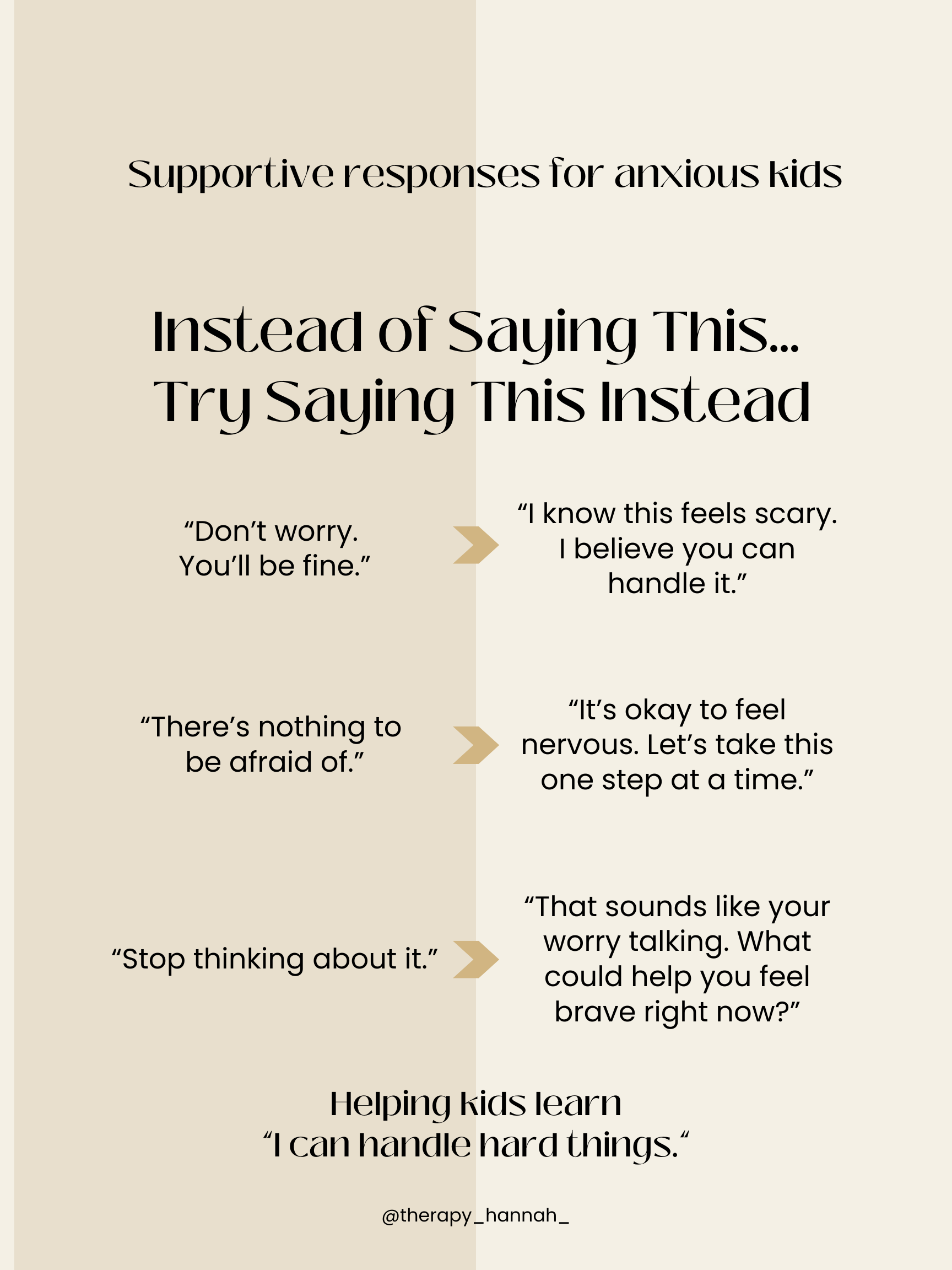
Instead of: “Don’t worry. You’ll be fine.”
This phrase is one of the most common responses parents give when a child is anxious. The intention is to reassure.
But anxious kids often hear something different:
“If my parent says not to worry, maybe I should be worried.”
Children with anxiety also tend to struggle with uncertainty. Simple reassurance rarely sticks for long before the worry returns.
Try saying instead:
“I know this feels scary. I believe you can handle it.”
This response validates the feeling while reinforcing the child’s ability to cope.
Over time, children begin to internalize the message:
“I can face things even when I feel nervous.”
Instead of: “There’s nothing to be afraid of.”
Parents often try to logically explain why a fear doesn’t make sense.
But anxiety isn’t driven by logic alone. Even when children understand something is safe, their body may still feel alarmed.
When a child hears that their fear “doesn’t make sense,” they may feel misunderstood or embarrassed.
Try saying instead:
“It’s okay to feel nervous. Let’s take this one step at a time.”
This response normalizes the emotion and focuses on small, manageable action.
Gradual steps help anxious kids build confidence through experience.
Instead of: “Stop thinking about it.”
When kids are stuck in a worry loop, parents may try to redirect by telling them to stop thinking about the problem.
Unfortunately, this rarely works. Anxiety tends to push thoughts back even stronger.
Many children interpret this response as:
“My worries are annoying.”
Try saying instead:
“That sounds like your worry talking. What could help you feel brave right now?”
This helps kids recognize anxiety as a mental process rather than a fact they must obey.
It also encourages them to focus on what action they can take, rather than getting stuck in the thought.
Instead of: “I’ll do it for you.”
When a child is overwhelmed, it can feel easier to step in and solve the problem.
For example, a parent might:
Speak for a child in a social situation
Order food for them at a restaurant
Complete a task they’re anxious about
This can reduce distress in the moment, but it also sends an unintended message:
“I can’t handle this on my own.”
Try saying instead:
“I’ll stay with you while you try.”
This provides support without removing the challenge.
Children learn that they can tolerate discomfort while taking action.
Instead of: “Just calm down.”
Anxious kids often hear this phrase when they’re already overwhelmed.
But telling someone to calm down rarely helps their nervous system settle.
Instead, children benefit from a parent who models calm and offers structure.
Try saying instead:
“Let’s pause together and figure out the next small step.”
This response helps slow the moment down and focuses on problem-solving rather than eliminating the feeling.
What Anxious Kids Actually Need From Parents
Many parents believe their job is to remove anxiety as quickly as possible.
But anxiety is a normal human emotion. Children don’t need to avoid it — they need to learn they can handle it.
Supportive responses teach kids:
Feelings can be uncomfortable but manageable
Courage grows through practice
Anxiety doesn’t have to control their choices
When parents consistently respond in ways that support bravery, children gradually develop confidence and resilience.
Parenting an Anxious Child Isn’t Easy
If you’ve said some of the phrases in this article, you’re not alone.
Almost every parent of an anxious child uses these responses at times. They are natural reactions when you want to help your child feel better.
The important thing is learning small shifts that encourage courage instead of reinforcing fear.
Over time, these small changes can make a powerful difference in how children learn to handle anxiety.
Want More Supportive Statements Like These?
If you want practical tools for responding to anxiety in the moment, I created a free guide for parents that walks you through a simple framework for creating supportive responses that help kids build confidence.
Inside you'll learn:
The key ingredients of effective anxiety responses
How to avoid reassurance traps
How to support bravery without increasing pressure
You can download the free guide here and start using these strategies with your child today.
